
INTERMEDIATE TECHNOLOGY
Finding Inspiration in Every Turn
Year 7 and Year 8 students from contributing schools attend Intermediate Technology each Wednesday throughout the year. The students are engaging with the technology curriculum and a variety of disciplines covering Hard and Soft Materials, Digital, Biotechnology, Digital & Visual Communication and Hospitality

Come Prepared
The programme for Intermediate Technology gives the students the opportunity to experience college life with hands on subjects.
The students are expected to wear covered shoes and come with a pen/pencil.
TECH SUBJECTS
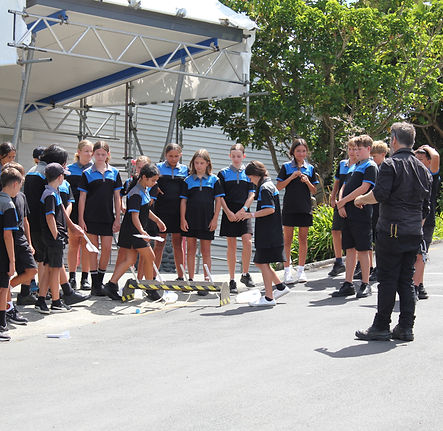
ENGINEERING TECHNOLOGY

Mr Gedye
Technology Coordinator -
nich.gedye@rodneycollege.school.nz
In Year 7 & 8 Technology, students develop practical skills using engineering tools and equipment. They explore how technological products are designed and constructed, and how technology influences and responds to our daily lives.
The course includes:
-
Workshop safety
-
Safe and accurate use of essential engineering tools and materials
-
Understanding how technological products are developed and the role of technology in shaping a dynamic society
Students build confidence in practical environments while developing an understanding of how ideas are transformed into real-world technological outcomes.

DIGITAL TECHNOLOGY

Mrs Anderson - HOD Technology
Course Overview: Innovators of Tomorrow
Focus: Robotics, Game Design and Digital Fluency
This course supports students to move from being passive users of technology to active designers and creators. Over five weeks, students explore how digital systems work and why they function as they do. Through a combination of robotics, circuitry and game design, students develop both hardware and software capability.
Aligned with the Technology curriculum, students learn to design, test and refine digital outcomes. They apply computational thinking, break problems into manageable steps, and develop solutions using digital tools.
By the end of the course, students will have created games and working circuits while developing critical thinking, creativity and the confidence to troubleshoot technical challenges. They also strengthen their ability to work safely and responsibly in digital environments.

TEXTILES

Mrs Riley
This year students explore how textiles fit
into our world today and how technology in fashion and fabric design continues to evolve.
Through the Technology curriculum, students follow a full design process - investigating materials, developing ideas for a purpose, planning, creating and evaluating a finished product.
Mastering the sewing machine is a practical challenge students enjoy and a life skill they will carry into the future.
Maths, creativity, problem-solving and patience will help them succeed and have fun along the way.
Students will design, cut and sew their own tote bag. This product is useful, sustainable and, best of all, thoughtfully designed and made by them.

MATERIALS & WOOD TECH

Mr Ferguson
This term in Hard Materials Technology, our
Year 7/8 students are combining craftsmanship with conservation. The class is designing and constructing native bird feeders for local species such as tūī, korimako (bellbirds) and waxeyes.
Students are following a full technological process. They are researching the needs of local bird species, developing a design brief, generating and refining concepts, and selecting durable materials suited to outdoor conditions.
This project focuses on:
-
Technological Practice: Developing a brief and planning a sequence of construction
-
Practical Skills: Measuring, cutting, joining and finishing materials safely and accurately
-
Sustainability: Designing for specific environments and ecological needs
-
Students are building confidence with tools while learning how thoughtful design can support our local ecosystem. We look forward to seeing the finished feeders in your gardens.

HOSPITALITY

Ms Parlane
This unit focuses on developing food
products using standard white flour. While preparing and cooking, students investigate the functional properties of flour and how it behaves in different processes, for example when forming and kneading bread dough.
Students explore how ingredients interact, how techniques influence texture and structure, and how understanding material properties supports successful outcomes.
We cover:
-
Doughs – quick breads, bread, pizza bases, scones and biscuits
-
Batters – fritters, waffles and brownies
-
Pastry – short (handmade) pasties and flaky (bought) apple strudel
Working collaboratively, being self-managing, reading instructions accurately and applying reflective thinking are key components of the learning process. Alternatives are provided for students who are gluten free or have food allergies

DESIGN & VISUAL

Mrs McMath
In DVC we look at the drawing and design
skills needed in areas of design such as Architecture and Industrial Design.
The course has three main areas of learning:
-
Design & Problem solving: Students will use creative thinking and problem-solving skills to reimagine a specific environment. By exploring the “why” and “how” of a space, they will generate and develop a unique design concept for a new spatial layout.
-
Visual Communication: Students will be taught 3D sketching techniques, specifically mastering one and two-point perspective. Using professional rendering and instrumental drawing skills, they will create realistic visual to express their design ideas on paper.
-
Prototyping & Physical Modeling: To complete the design cycle, students will translate their 2D plans into 3D, constructing a detailed cardboard scale model of their redesigned space.

BIO TECHNOLOGY

Mr Waata
In Year 7 & 8 Biotechnology, students learn
about our taiao (natural world) and develop environmental awareness through hands-on learning in mara kai (food gardens) and rongoa Maori (traditional plant-based knowledge). They explore how living systems function and how biological knowledge is applied within sustainable growing systems to support wellbeing and environmental outcomes.
The course includes:
• Safe practices in garden and science environments
• Seed germination, plant needs and growth cycles
• Applying sustainability principles in managed growing systems
• Exploring and practising rongoa Maori as applied biological knowledge
Students develop practical skills and an understanding of how biotechnology uses living systems for purposeful outcomes. This provides strong foundations for progression into Year 9–13 Science, including Biology and Environmental Science.